

 On
20 July, Havant Borough Council opened what is likely to be
the last real opportunity for residents to influence the Building
a Better Future Plan before it is handed to a
Government-appointed Planning Inspector for independent
examination. Given how much rests on this plan – it will
shape housing, employment and green space across the borough
through to 2043 – it’s worth taking stock of how we got
here, what’s genuinely at stake in the next six week
consultation period, and what residents can and can’t
usefully say at this particular stage.
On
20 July, Havant Borough Council opened what is likely to be
the last real opportunity for residents to influence the Building
a Better Future Plan before it is handed to a
Government-appointed Planning Inspector for independent
examination. Given how much rests on this plan – it will
shape housing, employment and green space across the borough
through to 2043 – it’s worth taking stock of how we got
here, what’s genuinely at stake in the next six week
consultation period, and what residents can and can’t
usefully say at this particular stage.
A plan with a previous life
This is not the borough’s first attempt at a new Local Plan
this decade. An earlier version went to independent
examination in 2021. Following the first round of hearings,
the Planning Inspectors wrote to the Council setting out
serious concerns. Most decisively, they found that the
Council’s public consultation had not followed the methods
its own adopted rules for community engagement had promised
– for example, leaflets and exhibitions in libraries that
had been committed to but not delivered. The Inspectors
judged this created a real risk that some residents,
particularly those without easy internet access, had been
shut out of the process, and their strong advice was that
the Council withdraw the plan, consult properly, and start
again. Separately, and worth remembering given what follows,
the same Inspectors also had serious doubts about two of
that plan’s largest housing sites – Southleigh and Campdown
– finding that neither could be shown, on the evidence at
the time, to be reliably deliverable. The Council withdrew
the plan.
The current process, branded Building
a Better Future, began soon afterwards, in March
2022. That July, Council
planning officers met representatives of twelve resident and
civic groups, Havant Civic Society
among them, to discuss the new plan and answer questions
submitted in advance. The answers given at that meeting
were, at the Council’s informal request, not published at
the time. Four years on, with the plan now reaching its
final public stage, we think it’s in the public interest to
publish that record in full, and we are doing so alongside
this post. It
makes interesting reading: Council
officers acknowledged in writing, a year after the 2021
Inspectors’ findings, that the Southleigh housing figures
had simply been carried over from the withdrawn plan “for
consistency” and would “need to be put back” to address the
Inspectors’ concerns, and confirmed that Campdown had
already failed the Government’s test for a deliverable site.
Both sites are back in this plan, at very similar housing
numbers, four years later.
Where things stand today
Since that 2022 meeting, the plan has been through further
rounds of consultation – on options in 2022, and on a full
draft in 2025 – before arriving at the version now going
forward for what’s called a “Regulation 19” consultation:
the publication stage, where the Council presents the
version it believes is ready for examination.
Running alongside it, two of that plan’s largest individual
housing sites are themselves live planning applications,
working through their own separate public consultation and
decision process: Southleigh,
a proposed community of up to around 1,800 homes between
Havant and Emsworth, and Campdown,
a 590-home development on Portsdown Hill. Between them,
these two sites are expected to supply close to a third of
the entire Local Plan’s housing total for the next two
decades. The Southleigh application alone has, in the first
three weeks since it was published, attracted 763 recorded
objections from the public – an exceptional number for a
single planning application, and a clear sign of the depth
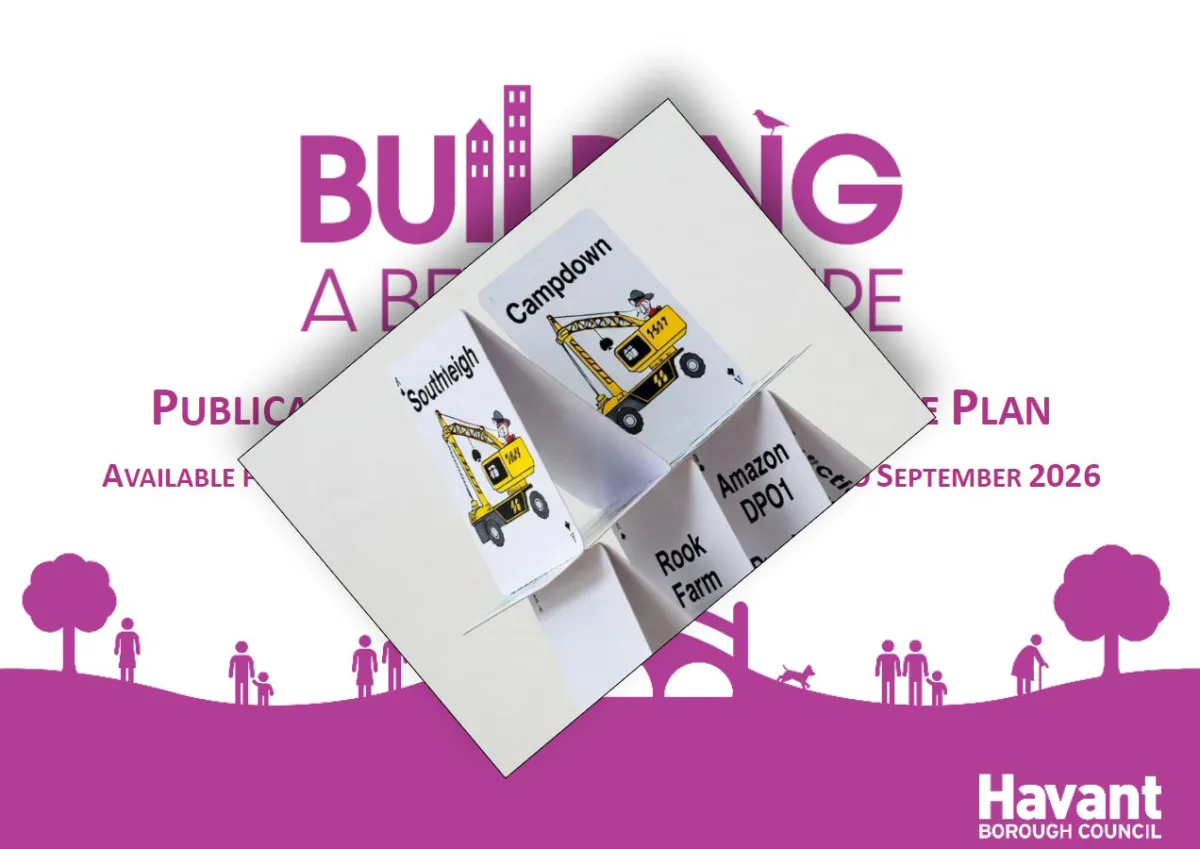
of local concern. Southleigh and Campdown – 1,800 and 590
homes respectively – risk
being determined on a planning record that
the council itself cannot confirm is complete, accurate, or
safe from legal challenge.
This overlap matters for more than just scheduling reasons.
If either site turns out not to be deliverable in the way
the plan assumes – because the road network genuinely cannot
absorb the traffic, or because infrastructure the plan
itself requires isn’t actually going to be funded – that is
not a small technical footnote. It goes to whether the plan
can honestly be called deliverable at all, given it is
already relying on these two sites for such a large share of
its total housing numbers. Pushing the plan towards
examination while that exact question remains unresolved, on
two sites an Inspector already found undeliverable once
before, is a real risk the Council is choosing to run, and
residents are entitled to say so.
What residents can actually say right now
This is the point in the process where it’s easy to get the
wrong idea about what kind of comment is useful. Earlier
rounds of consultation, in 2022 and 2025, were genuinely
open to residents saying “I don’t want this development
here” or “I’d prefer a different approach.” This Regulation
19 stage is different, and it catches a lot of people out.
At this stage, the Council has already decided this is the
version it believes is ready, and the rules only allow
comments on two narrow questions: is the plan legally
compliant, and is it sound.
General objections to a policy you simply disagree with,
however strongly felt, carry little weight here – they
needed to be raised earlier. What the Inspector wants to
hear now is whether the plan has followed the correct legal
process, and whether it stands up to scrutiny on its own
terms.
An example of a soundness point: one of the four legal tests
for soundness is whether a plan is “effective,” meaning
genuinely deliverable over its lifetime, not just on paper.
If a plan leans on two sites for roughly a third of its
total housing supply, and the developers’ own submitted
evidence for one of those sites shows local road junctions
failing and a piece of infrastructure the plan itself
requires – a walking and cycling bridge over the railway –
has reportedly been dropped for lack of funding, that is a
legitimate, evidenced soundness argument: the plan cannot
currently be shown to be effective as written.
An example of a legal compliance point: the Council’s
adopted rules for how it will consult the public (its
Statement of Community Involvement) set out the specific
methods it commits to using. Given that the Council’s
previous plan was withdrawn specifically because it failed
to deliver the consultation methods it had promised, it is
entirely fair for residents to check whether the current
consultation – which appears to rely heavily on a website,
an online form and an email mailing list – actually matches
what the Council’s current rules commit to, and whether
residents without easy internet access are genuinely able to
take part on equal terms.
What we’d encourage residents to do
Read the plan, and if you have concerns, use the
official Regulation 19 representation form to
raise them, framed around whether the plan is legally
compliant and sound – that is what will actually be read and
weighed at examination. We’ll be publishing more detailed
guidance and our own submissions on both the Local Plan and
the Southleigh and Campdown applications in the coming
weeks, but we didn’t want residents to wait for that before
understanding the history behind this plan, or what kind of
comment will actually count in the next six weeks. The full
record of the Council’s 2022 answers to residents’ groups, published
alongside this post, is there for
anyone who wants to see the fuller picture for themselves.
Havant Civic Society 24th July