


Past pupils and teachers have
returned to Bourne Community College to celebrate the
school's platinum jubilee.
Photographs and memorabilia were
laid out for all to peruse on Friday, January 9, to mark the
70th anniversary, and the whole community was invited to
take tours of the school.
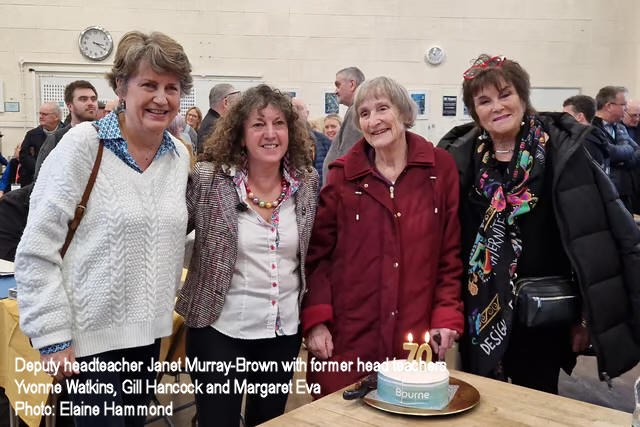
Mrs Janet Murray-Brown, deputy
headteacher, spoke passionately of the school's success
before raising a toast.
She said: "The platinum jubilee of
our school marks not just the passing of time but the
building of a legacy. Since opening its doors in 1956, the
Bourne has been at the very heart of the local community,
and indeed the wider community, too. That relationship has
not only endured but continues to flourish in today's
ever-changing society."
The school opened its doors on
January 10, 1956, to 345 children aged 11 to 14. It replaced
the old Southbourne school, which had been built at the end
of the 19th century for 100 pupils but was catering for 500
before the new building was opened.
The first headmaster, Mr R.B.
Barnes, said it was 'a grand building', adding: "At times,
of course, in those early days, there were many
distractions. Members of the staff would wonder whether it
really was a workman at the end of the corridor rather than
a senior boy, whether that paint was dry and whether we
should ever get rid of all that mud surrounding the school."
The school was planned on an
11-acre site in Park Road, Southbourne, adjoining the
Chichester Rural District Council housing estate, and the
name was derived from the ancient name of the parish of
Westbourne.
The district had been partially
re-organised since 1949, when it was arranged that senior
children from Southbourne, including West Thorney, Compton
and Stansted schools should be concentrated in the
Westbourne school, which retained an infant department but
transferred its junior children to Southbourne school.
The completion of Bourne County
Secondary School enabled the rest of the all-age schools in
the district – Bosham, Chidham and Funtington – to be
reorganised as junior and infant schools, and the older
children given the advantages of secondary education in an
up-to-date and well-equipped building.
The new school had an assembly hall
with stage, gymnasium with changing rooms and showers, seven
classrooms, a geography room, library, needlecraft room,
arts and crafts room, housecraft room with small
demonstration flat, handicraft room and science laboratory.
Two of the seven classrooms were
used for dining and meals were served from the adjoining
canteen kitchen. There were also room for staff and medical
inspection, a paved outside area and a playing field.
The official opening of Bourne
County Secondary School did not take place until June 29,
1956. Mr H. Harmer, from Haselemere builders Chapman, Lowry
and Puttick Ltd, passed the gilt presentation key to
16-year-old boy school captain Martin Pruce and he then
handed it to Sir Frederick Brundrett, chairman of the
defence research policy committee, to unlock the door and
enter the school.
Sir Frederick and Sir Herbert
Shiner, chairman of the county council, lead a procession
into the hall, where the rest of the audience was assembled
for the official opening.
Sir Frederick said: "In my school
days, no schools existed anywhere like this very remarkable
building."
The school's 'ultra-modern, high
fidelity loudspeaker system' was showcased at the opening,
allowing the children in the classrooms to hear the
speeches.
Among many highlights over the
years was the introduction of a Post Office saving stamp
scheme in January 1963 to help children to save, rather than
spend their money.
In December 1975, a metal sculpture
was presented to the school by RAF Thorney Island. The
commanding officer arrived in a helicopter and made the
presentation in the assembly hall. In return, the RAF was
presented with a map of the school catchment area and a copy
of Cyril Sealy's book Twenty Years On…
The school's long association with
the base included the 'inconvenience' of the aircraft noise
on lessons and former pupils coming to the rescue when an
RAF plane crashed off Thorney Island in May 1962.
Mrs Murray-Brown said much had
changed over the seven decades, and the landscape of the
Bourne had evolved dramatically.
"We now proudly boast the Barnes
Building, the science block, the Bourne Leisure Centre, the
STEM building, and the 4G Southgate Pitch, developments that
past generations may once have thought belonged more to
science fiction than a school campus," she said.
"We've journeyed from chalk and
blackboards to whiteboards to overhead projectors, which
many of us remember never quite working when you needed
them. Then to interactive boards and now, incredibly, to
artificial intelligence. What next, we wonder?
"Yet, despite all of this progress,
one thing has never changed. As Mr Cyril Sealy, in his
historical account, said in 1976, the passion to ensure that
every student does their very best remains at the core of
the Bourne.
"Tools may evolve, buildings may
rise, and technology may advance, but dedication, care, and
ambition for the young people endure. Today is an
opportunity to look back at past achievements, reflect on
our success, take pride in our contributions to the
community, and look forward to the next 70 years. Bourne is
more than bricks and mortar. It is a community, a family,
and a shared story, 70 years in the making."
For the many people who were unable
to attend, the school has planned a second celebration event
on Saturday, March 21, from 10am to 4pm.
Sussex World 12th January