


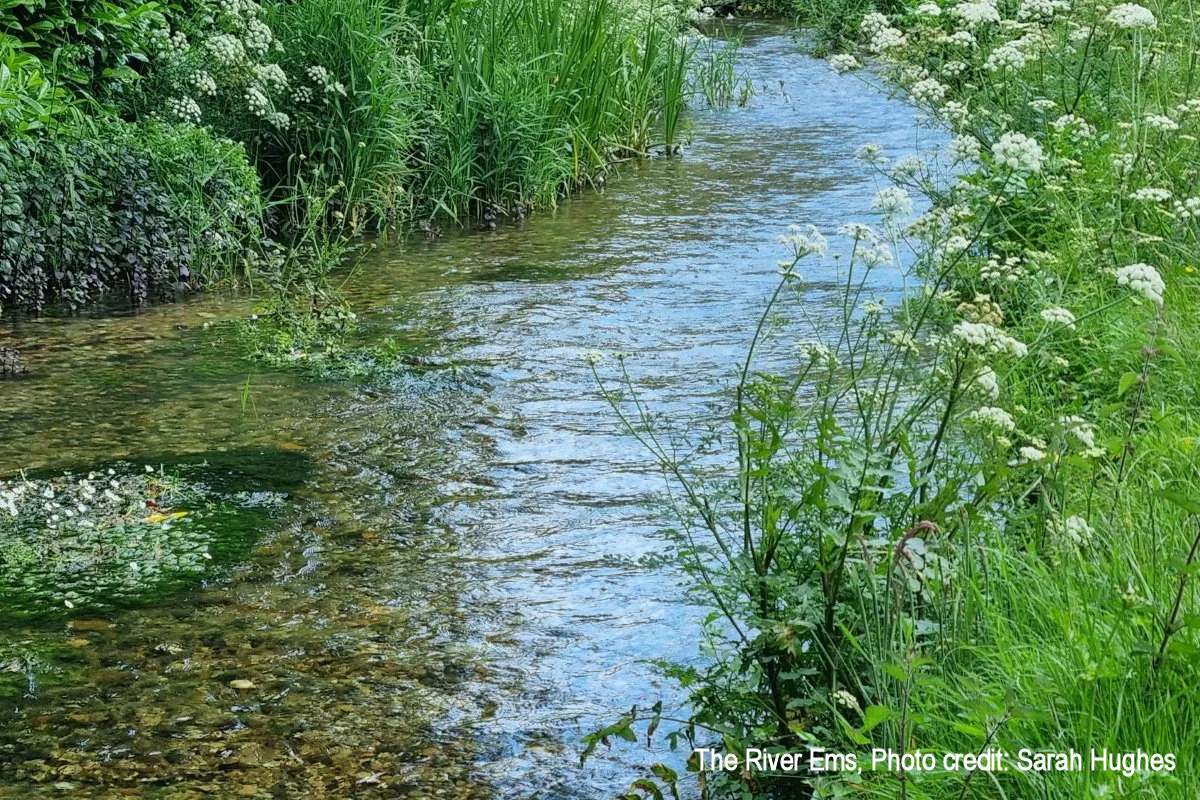
Stand by the River Ems today and
something feels wrong. This chalk stream, rising in the
South Downs and slipping quietly towards Chichester Harbour,
once ran cold and clear through its meadows. Now, in places,
it is sluggish, shallow, or dry. What was once a living
thread through the landscape now looks like a river that’s
been allowed to fade away while everyone involved insists
they’re doing their best.
And that’s the question at the
heart of this: Who failed the Ems? Was it Portsmouth Water,
with its pumping and its patchy augmentation schemes? Or was
it the regulators and governments who handed out abstraction
licences (a legal permit required to extract water from
natural sources, ensuring sustainable water management and
environmental protection) as if rivers were bottomless, and
then walked away?
The honest answer – and the one
people don’t like because it can’t be squeezed into a neat
headline – is that there’s blame to spare.
A river treated as spare change
Locals have been raising the alarm
for years. They’ve watched stretches of the Ems shrink to a
trickle, seen fish stranded in dwindling pools, and
photographed dead sections where the river simply gave up.
Community groups have done more surveying and data-logging
than some of the agencies meant to protect these waters.
Portsmouth Water doesn’t deny the
Ems is struggling. In fact, to their credit, they’ve
published technical reports, run flow-augmentation trials
and launched a five-year environmental study into the state
of their rivers. They say that some abstraction doesn’t pull
directly from the visible river, and that they use a
borehole removed from supply to top up flows in crisis
periods.
All correct on paper, but paper
isn’t the river
The Ems is a chalk stream. Pump
water out of the aquifer and the river feels it, whether the
pumps are beside it or miles away. And while augmentation is
supposed to be the safety net, it has not always reached the
parts of the river most in need. Independent appraisals say
as much. Water released upstream has vanished into porous
ground, or simply failed to travel far enough to protect the
weakest stretches. It’s a system that works in theory but
too often lets the river down in practice.
But then there are the licences…
Here’s
the part people sometimes forget: Portsmouth Water didn’t
create its own licences. Those permissions were issued – and
repeatedly renewed – by
the Environment Agency
(EA), under rules shaped and overseen by successive
governments.
Most of those licences date from a
time when environmental pressures were different, population
growth was lower and climate change wasn’t biting into
summer flows. And yet those old permissions, set in a
different era, still dictate how much can be taken today.
The EA has said it is reviewing
Portsmouth Water’s abstraction licences in the Ems
catchment. It has that power, and some would argue it has
had cause to use it sooner. But regulators are stretched
thin. Licence reviews take years. And rarely does a
government allocate the funding or political momentum needed
to overhaul a system that’s been outdated for decades.
So when we ask who is to blame,
it’s not as simple as pointing at a pump and shouting
“there”. Behind every abstraction is a licence. Behind every
licence is a policy. And behind every policy is a government
that chose not to reform fast enough.
What’s really being lost?
It’s tempting to treat all this as
paperwork and pumping data, but the real loss is on the
riverbed.
A chalk stream depends on steady,
cold, oxygen-rich water. Lower flows mean warmer
temperatures, fewer plants, collapsing insect populations,
and a food chain that buckles from the bottom up. If you
want to understand the seriousness, talk to the people who
walk the river at dawn, or the volunteers who’ve watched
once-reliable springs cough air instead of water.
The restoration plan drawn up by
local river trusts is blunt: without a major rethink of
abstraction levels, habitat work alone won’t be enough to
bring the Ems back. This is not a river that will fix itself
with a few days of rain and a photo-op.
The politics: Plenty of noise, less
action
Chichester’s former Conservative MP
Gillian Keegan has given the Ems a voice locally, challenged
Portsmouth Water directly. That matters. It forces
statements, meetings, and uncomfortable conversations
between regulators and water companies.
But as we’ve all seen before,
politicians can shout loudly, governments can nod gravely,
and rivers can still die quietly.
What we need is more than noise –
we need the system itself to change. That means modernising
abstraction laws, giving regulators the teeth and the budget
to enforce them, and demanding transparent data from
companies so the public can see what’s being taken from
their rivers in real time.
So far, none of that has fully
materialised.
So who is responsible?
People prefer villains. It’s easier
that way. But the Ems wasn’t lost overnight, and it wasn’t
harmed by one bad actor.
Portsmouth Water bears
responsibility for how it operates its pumps, for the design
and delivery of its augmentation, and for the choices it
makes when the river is gasping. The Environment Agency
bears responsibility for issuing and maintaining licences
that no longer ensure the river’s survival. Government, past
and present, bears responsibility for underfunding the
regulators and failing to reform a system everyone knows is
creaking.
That’s the uncomfortable truth: the
river sits at the intersection of corporate decisions,
regulatory inertia, and political delay.
The Ems is not gone. It is fragile,
diminished, and in places damaged – but not beyond saving.
Everyone involved knows what the river needs: realistic
abstraction limits, monitoring that isn’t optional,
restoration that is long-term, and political will that
survives more than a news cycle.
If any good is to come from the
state of the Ems, it will be this: that we stop treating
rivers as background scenery and start treating them as what
they are – living systems that only thrive when the people
who manage them take their responsibility seriously.
And this time, we shouldn’t accept
soft words. The river deserves better than that.
By
Oak Bear 13-12-2025 08:00in Environment, Sussex
Sussex ByLines 8th January