

About Emsworth - the Town's History
EARLY EMSWORTH
Emsworth was founded as a planned village around 1215.
Its original burgage plot frontages are observable
surrounding the market square.1.
At first it was linked to the more important
settlement of Warblington nearby. People from Emsworth
worshipped at St Peter's Chapel or in the church at
Warblington. However, Emsworth was not mentioned in the
Domesday Book of 1086. It was probably too small to be
mentioned on its own and was included with Warblington.
The name Emsworth was probably once Emel's worth or
Emil's worth. A worth was an enclosure like a farm or
hamlet surrounded by a palisade.
Although Emsworth started as a small settlement it soon
grew to be larger and more important. In 1239 Emsworth
was granted the right to hold a market. (In those days
there were few shops and if you wanted to buy or sell
anything you had to go to a market. Emsworth was also
allowed an annual fair. (In the Middle Ages fairs were
like markets but they were held only once a year and
people traveled long distances to buy and sell at them.
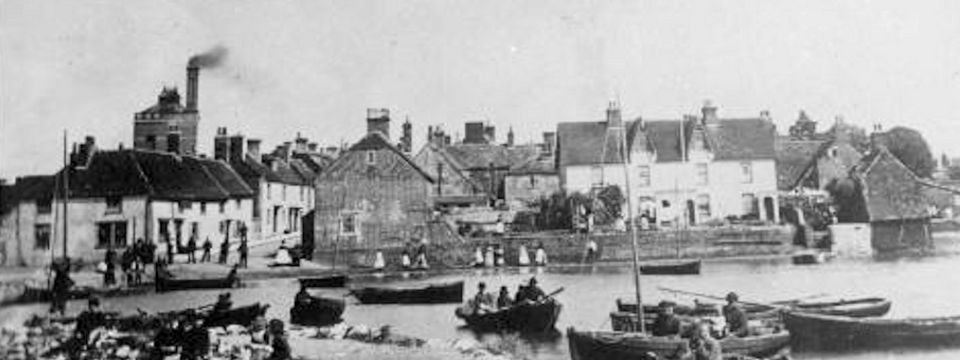
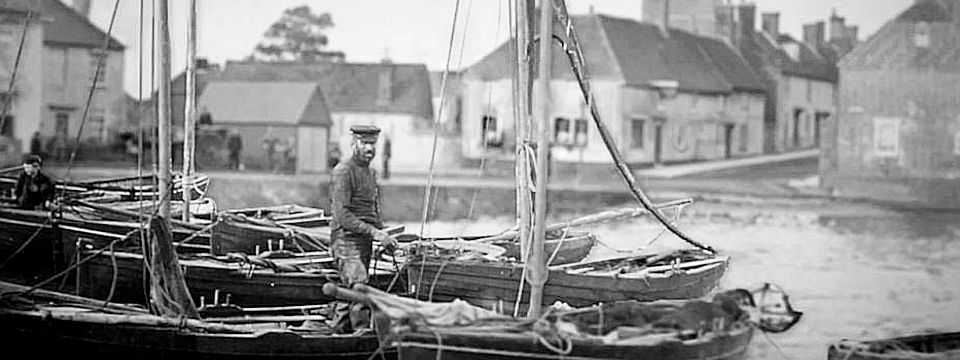
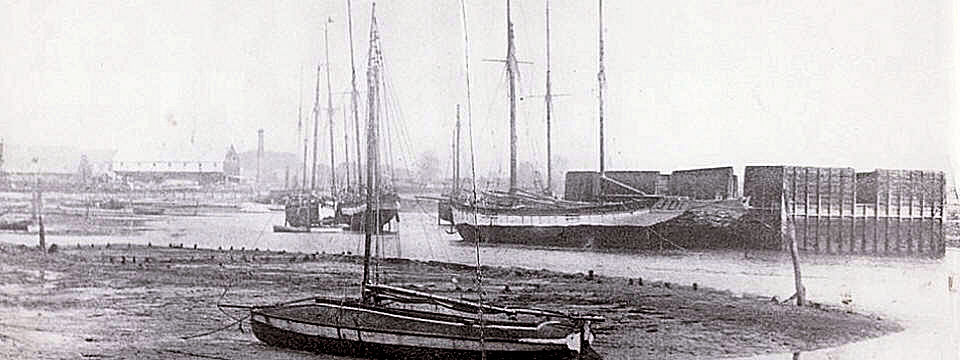
In the Middle Ages Emsworth was a busy little port.
Large quantities of wine (the drink of the upper class)
were imported from Europe through Emsworth.
In the 18th century and the 19th century Emsworth was
known for shipbuilding, boat building and rope making.
King Street is named after a man named King who settled
there in the late 18th century and started a ship
building business.
EMSWORTH IN THE 18th & 19th CENTURIES
During the 18th and 19th centuries Emsworth was still a
busy little port. Grain from the area was ground into
flour by mills. At Emsworth there were tidal mills. When
the tide came in water was allowed to flow in behind a
barrier. When the tide turned the water was trapped and
it was only allowed to flow out under a mill turning its
'wheel'. The flour was transported by ship to places
like London and Portsmouth.
Timber from the area was also exported from Emsworth in
the 18th and 19th centuries. Coal (a very necessary
commodity when everyone had a coal fire) was brought to
Emsworth by sea. Emsworth was also known for its fishing
industry especially in the oyster beds around the town.
Read more about The
Emsworth Oyster Fishery
In the 19th century Emsworth was also known for its
brewing industry.
At the beginning of the 19th century Emsworth had a
population of less than 1,200. It would seem tiny to us
but settlements were very small in those days. By the
standards of the time Emsworth was a large town
At the end of the 18th century it became fashionable for
wealthy people to spend the Summer by the sea. People
believed that bathing in seawater was good for the
health. In 1805 a Princess came to Emsworth and a
bathing house was built where people could have a bath
in seawater. Bath Road is named after it. However
Emsworth failed to take off as a seaside resort.
The Church of St James was built in 1840.
Queen Victoria visited Emsworth in 1842. Queen Street is
named after her.
In 1847 the railway came to Emsworth.
MODERN EMSWORTH
by 1901 the population of Emsworth was about 2,000. It
grew rapidly during the 20th century. By the middle of
the 20th century the population of Emsworth was about
5,000. (The 1,000th house in Emsworth was built in
1953). Today the population of Emsworth is about 9,300
Emsworth Recreation Ground dates from 1909.
In the 20th century Emsworth became a resort for
pleasure boats. The oyster fishing industry declined
after 1902 when sewage polluted the oysters. Some people
died after eating oysters from Emsworth. Fishing oysters
at Emsworth ended until new sewers were dug but the
industry never completely recovered.
By Tim Lambert
Notes:
1.The Emsworth site being under water in Saxon times. An 11th century drop in sea level made the ridge between the two streams buildable – also making Langstone and Warblington facing shallower water. (Calais was formed at the same time on what were previously sandbanks on the other side of the Channel.) In pre-Norman times the River Ems was tidal up to Westbourne, hence the village’s growth at the head of the creek.
Bob Smyth 2018